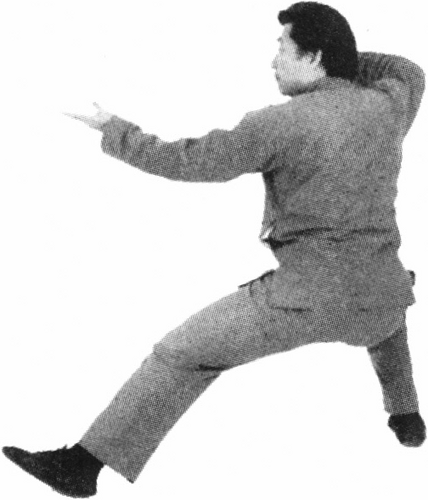
Instruction 4 (Figure 9-455) Left foot advances 45 degrees to the left, foot follows the ground, while both hands are moved to shoulder level.
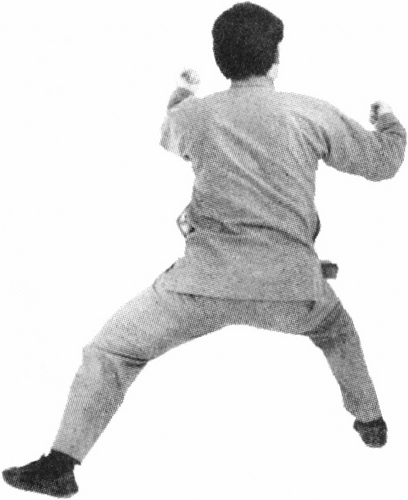
Instruction 5 (Figures 9-456, 457) Body turns right, weight shifts to the left, while both hands transform into fists: left fist sweeps in an arc to the left chest, right fist sweeps outward in an arc to the right shoulder diagonally upward.
 |
 |
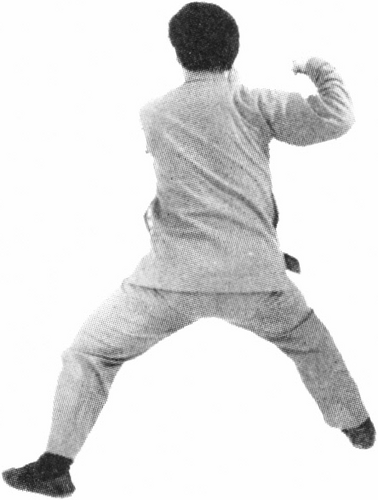 |
Fig 9-455 |
Fig 9-456 |
Fig 9-457 |
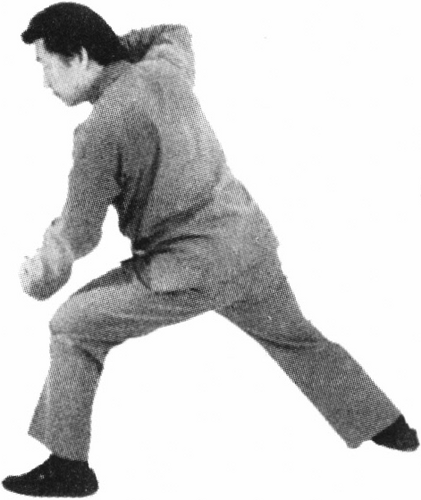
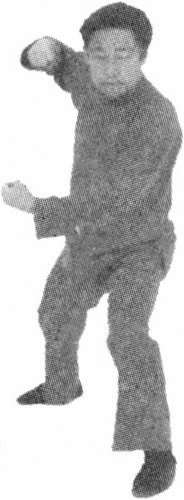
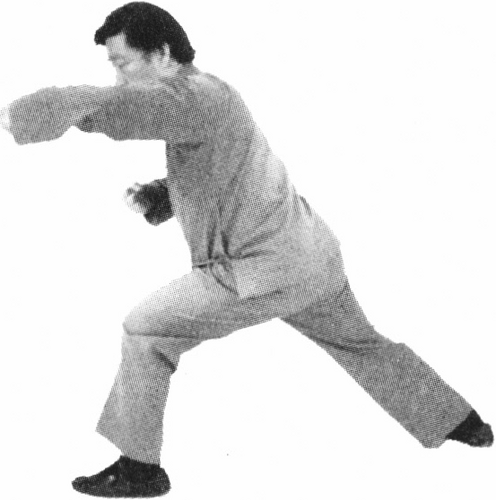
Instruction 6 (Figures 9-458, 459, 460) Body turns left, weight shifts to the left leg, while both arms follow the body's left turn and move downward: left fist sweeps outward in an arc to the left upper side, right fist descends from the right shoulder (facing west).
Key Points:
1. The key point of this posture is to keep the tailbone centered; this will prevent the body from tipping forward, which is achieved by pressing the tailbone downward, allowing the entire spine to be stretched. Only when the spine has sufficient elasticity can you forcefully spring upward; if the tailbone is inverted, the elasticity is lost, and the body cannot rise again.
2. In the squatting posture, the top of the head must remain firm; this is achieved by both fists forming a circular motion. This not only stretches the spine but also rotates the top of the head. Thus, it is also called "Divine One's Grip." After a circular motion, the fists become fists, then the fists strike downward, as if turning over the soil and planting seeds. Thus, it is also called "Gripping and Striking."
 |
 |
 |
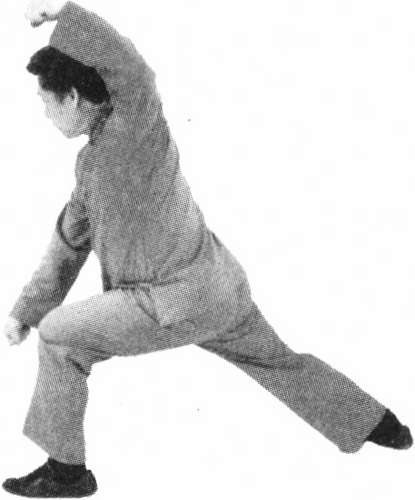 |
Fig 9-458 |
Fig 9-458B |
Fig 9-459 |
Fig 9-460 |
Yin and Yang interact, hidden by the Tao, motion and stillness are balanced, and thus your strength arises.
326