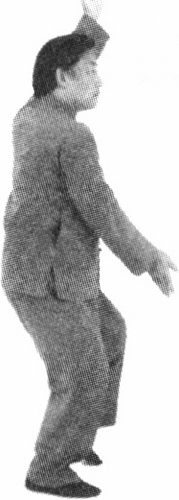
Instruction 2 (Figures 9-246, 247) Both arms continue to arc, forming a left hand above and right hand below; the left arm bends and sinks, while the right hand transforms into a fist held at the left side of the torso, with the center of gravity sinking.
 |
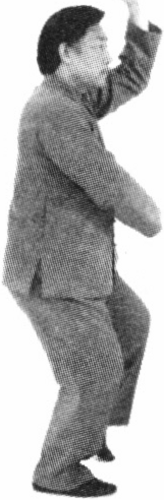 |
Fig 9-246 |
Fig 9-247 |
Note:
The characteristics of the previous posture and this one are to achieve a state of joint connection and simultaneous motion and stillness. Thus, the left foot rotates around the left foot's pointed tip, following the body's rotation; however, pay attention that "虚" (empty) is not entirely powerless, and "实" (solid) is not completely stationary. Regarding this point, refer to the key points of the fifth posture "Single Pivot".
From the previous posture to the final position of this posture, further ensure that the top of the head rises in a subtle, effortless manner. After long-term practice, this posture may cause cervical and thoracic upper spine joint clicks, which is a natural phenomenon after prolonged practice and should not be forced to avoid generating stiffness. Only when you achieve this state can you confirm that the movement in this posture has reached the requirements of full joint motion and relaxed joints.
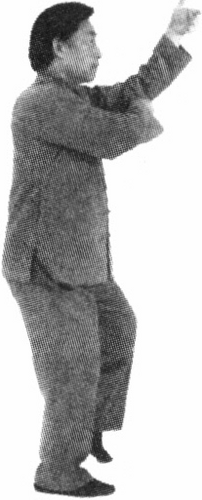
Instruction 1 (Figures 9-249, 250) The left hand first rises and then descends, while the right hand transforms into a fist raised upward.
 |
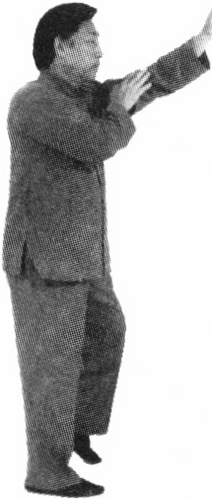 |
Fig 9-249 |
Fig 9-250 |
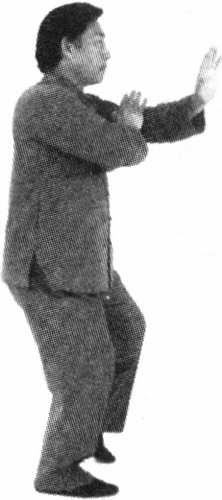
Instruction 2 (Figures 9-251, 252) The left leg takes a step backward, while the left hand arcs downward and the right hand arcs upward, dividing, with the center of gravity on the right leg and the palm pointing downward.
 |
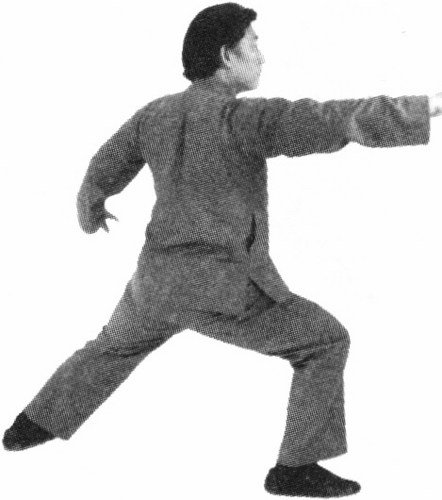 |
Fig 9-251 |
Fig 9-252 |
300