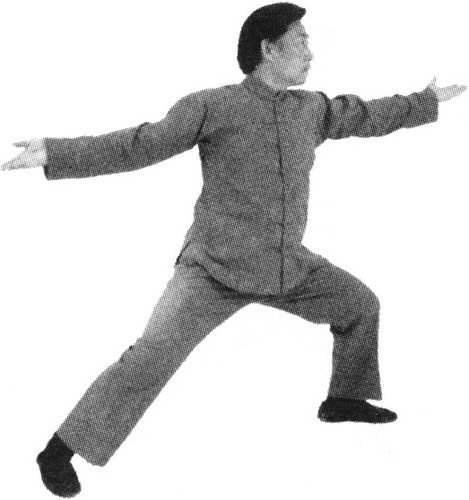
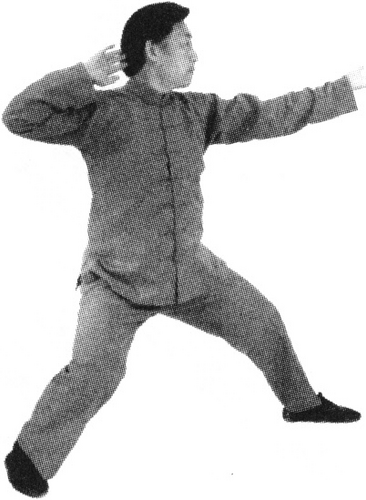
Instruction 9 (Figures 9-265, 266) — See Figures 9-257, 258 for illustration.
 |
 |
| Figure 9-265 |
Figure 9-266 |
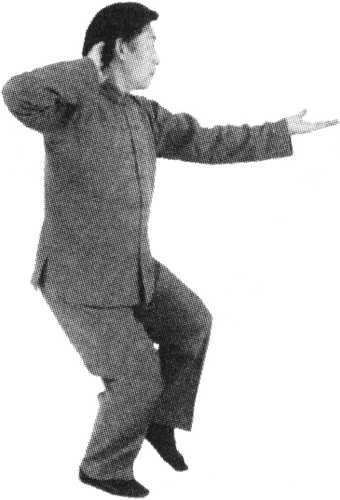
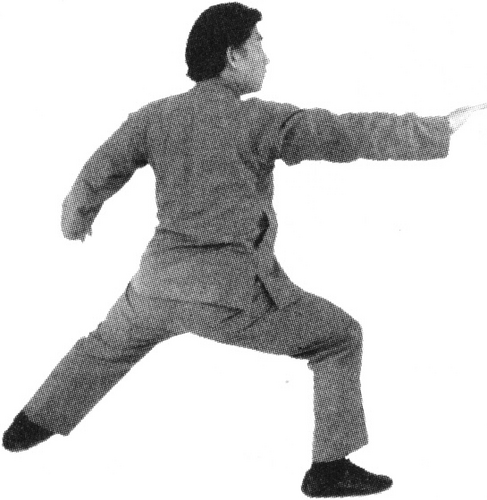
Instruction 10 (Figures 9-267, 268) — See Figures 9-251, 252 for illustration (facing northeast).
Note:
During continuous backward retreat, it is not a smooth, sliding backward movement. According to the requirement "retreat must involve a turn," during the two steps of retreat, there must be a transition between an open posture and inward force. Only then will you not perceive it as a smooth backward movement, but rather as a continuous application of forward and backward force. Simultaneously, with the transition, it becomes a retreat with forward movement — retreat is forward, and forward is retreat, with natural movement, making it a retreat technique in Taijiquan that supports all eight directions. During retreat, there must be a subtle reverse spiral, and it must be performed in a circular, smooth manner.
This posture can also be performed as an outward explosion, i.e., when stepping backward to the end point, make a grounded step and emit a sound, while simultaneously extending the front hand outward, and using the back hand to sink and hold firmly.
 |
 |
| Figure 9-267 |
Figure 9-268 |
 |
 |
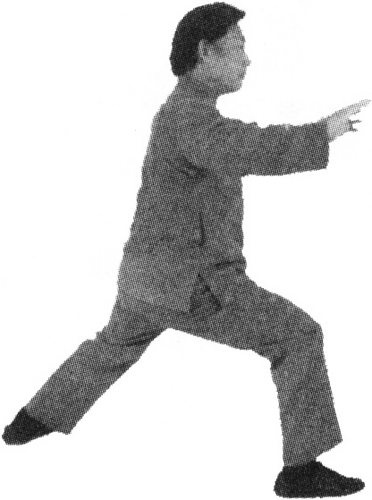 |
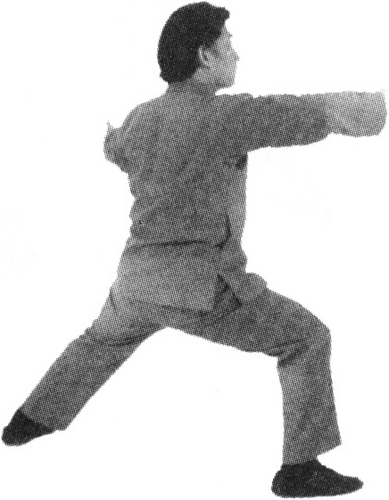
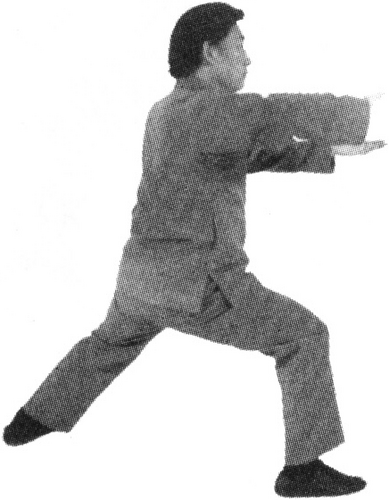
| Figure 9-269 |
Figure 9-270 |
Figure 9-271 |
Instruction 1 (Figures 9-269, 270, 271) Turn body right, bring left hand and right hand together on the right side of the body, with palm facing down.
303