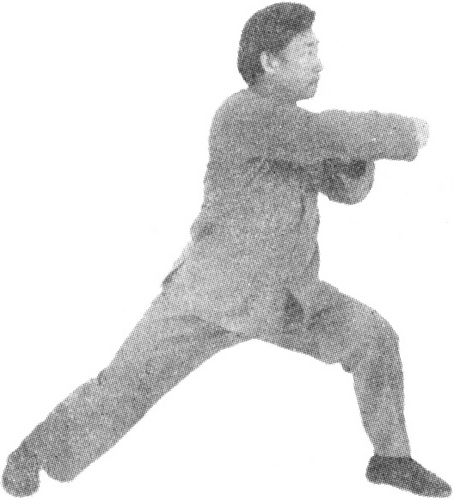
Instruction 4 (Figures 9-864, 9-865) Body turns right, center of gravity shifts to the right leg, right knee bends and lowers, while both fists arc left and right, left fist placed inside the left leg, right fist positioned above the body on the right side, fists facing each other (facing south).
Note: 1. The difference from the jumping stance is that this posture does not involve jumping; the right leg does not touch the ground as the right arm rotates from above the right knee, but must still be lowered as much as possible; all other parts are the same as in the jumping stance. 2. This posture first performs a double fist coiling motion, then releases (using centrifugal force), and at the extreme opening and low position, again utilizes the released hands to reunite with inward force, applying the force to the right fist, serving to lift the body.
 |
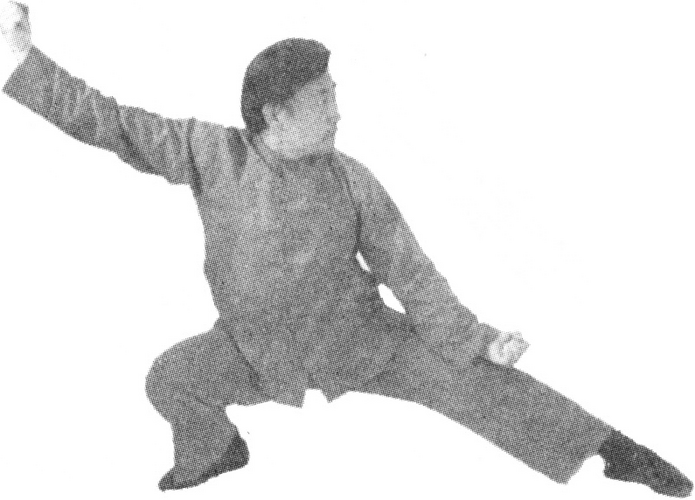 |
Fig 9-864 |
Fig 9-865 |
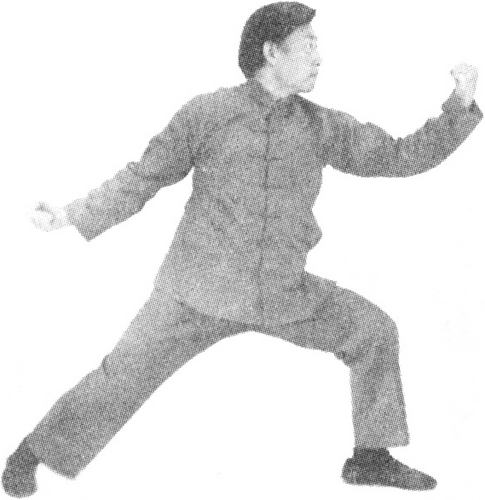
Instruction 1 (Figures 9-866, 9-867) Body turns left 90 degrees, center of gravity shifts to the left leg, right foot steps forward, toes point to the ground, while both fists arc left and right, crossing and retracting to the chest, right fist outside, fist facing inward (facing east).
 |
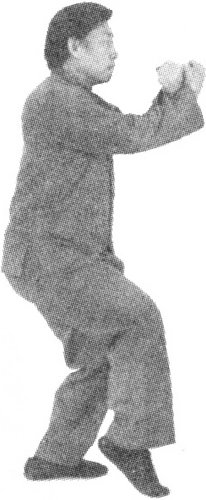 |
Fig 9-866 |
Fig 9-867 |
Instruction 2 (Figures 9-868 to 9-871) Body slightly lowers, while both fists transform from fists to open palms and push forward.
Note: In Taijiquan, every fist movement requires a state of stillness during motion, with a primary moving part in each posture; this posture focuses on the forearm, providing good training for the forearm. However, in other postures, the forearm is also in motion, and in this posture, other parts are also in motion; here, we focus on one primary part.
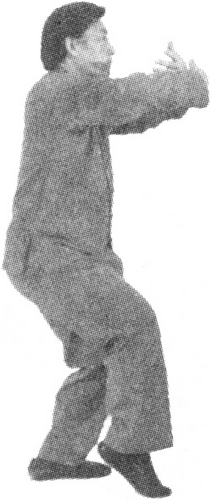 |
Fig 9-868 |
378